
MastnodeHear the ships. Own the coast.
The maritime DePIN node.
Mastnode turns any coastal spot with a sea view into earning maritime infrastructure — a compact indoor receiver, wired to an outdoor antenna, that captures live vessel traffic, signs it at the source, and rewards you in $MAST and $ONO around the clock.
◈ Explore the Mastchain network ↗One device. Two networks.
Two token streams.
Your node receives live AIS signals from vessels up to 40+ nautical miles offshore, signs every message at the source, and relays it to Mastchain ↗. Coverage quality and uptime drive rewards, hex by hex.
The GNSS chip streams RTK correction data to the Onocoy network in parallel — no second device, no second install.
Antenna requirements ↓Tools & media hub


Models & what's
in the box
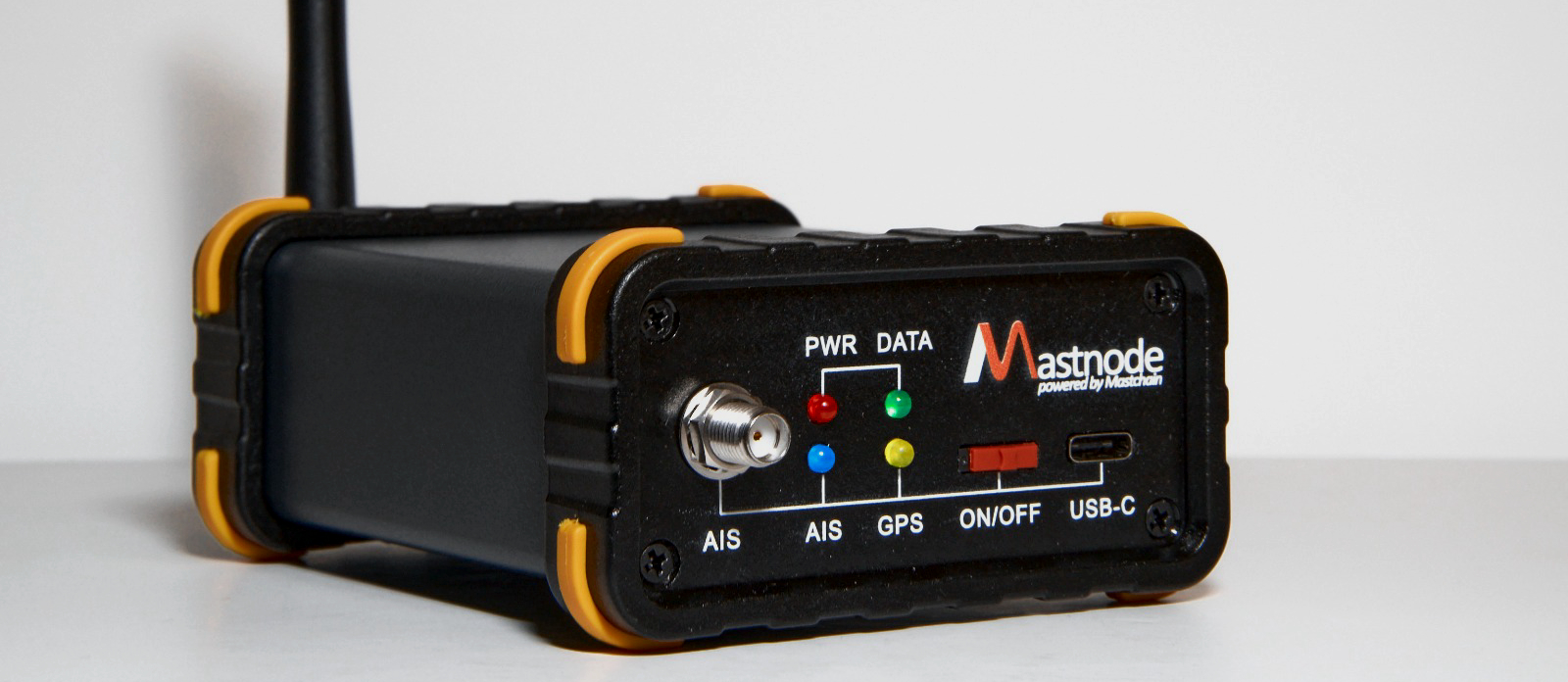
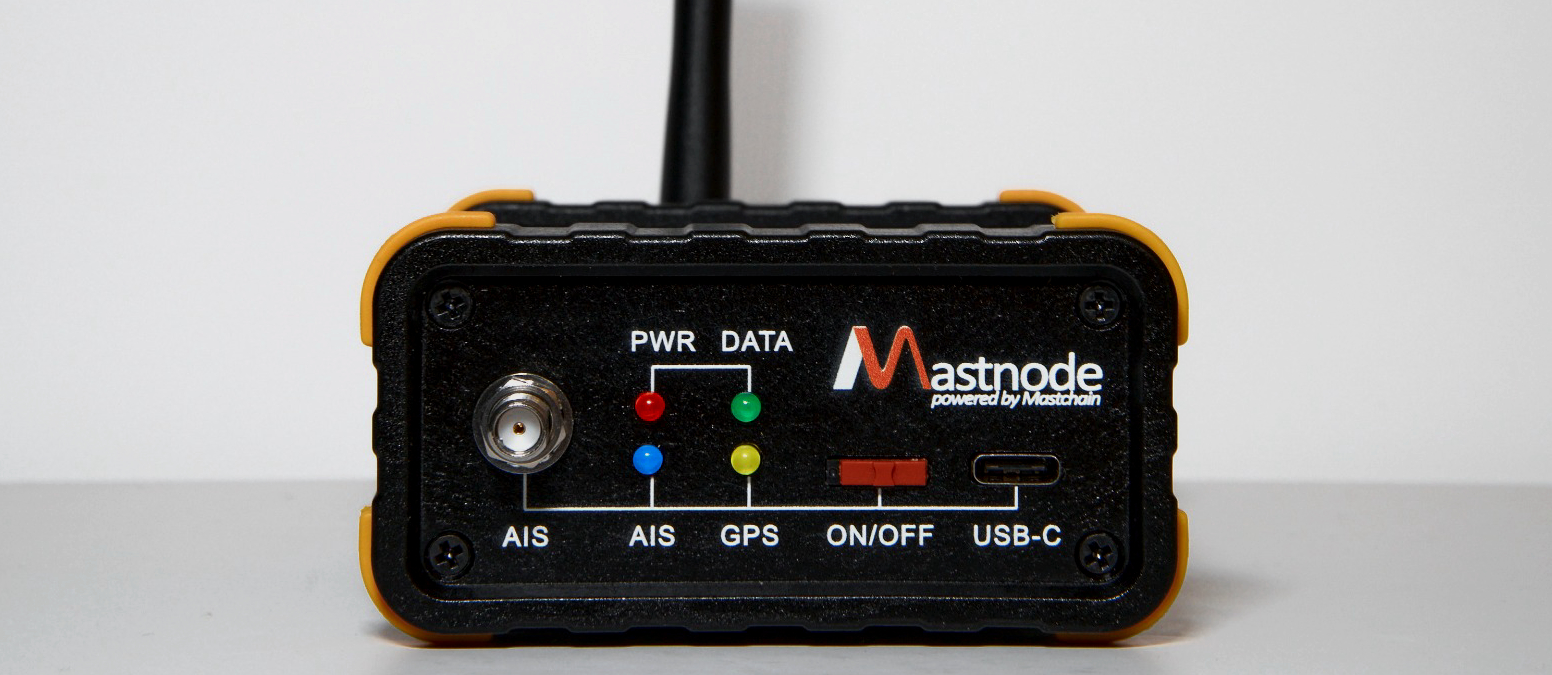
★Standard Mastnode is dual-mining capable too. It ships with a passive GNSS patch antenna and earns $MAST from AIS out of the box. To also mine $ONO on Onocoy, add an active mushroom RTK antenna & coax cable (available separately), or feed an existing GNSS antenna through a DC-blocking splitter — see the antenna-sharing FAQ.
◆Gold rows are the extras the “+ RTK” package adds over the standard Mastnode: the active mushroom GNSS antenna, GNSS coax cable and RTK calibration — ready for Onocoy straight out of the box.
⚡Power: each package includes a USB-C power cable — not a wall plug. Use any USB adapter rated at least 5V / 2.5A (12.5W), which most phone chargers and powered USB hubs already provide.
Official distributors & ecosystem


Frequently asked
How is Mastnode shipped?
Where should I install it?
What do I need to run it?
Do I need the mushroom antenna?
I already run another GNSS miner (Geodnet etc.) — can I use its active GNSS antenna with Mastnode?
Yes — with a GNSS splitter. A passive 1×2 splitter lets Mastnode and your existing receiver listen to the same active mushroom antenna, so you don't need a second antenna on the roof.
The catch is power. An active antenna is fed 3–5 V DC through the coax by the receiver. If two receivers both push DC into one antenna, the voltage sources fight each other — and can damage the antenna's LNA or both receivers. The splitter must therefore feed DC through exactly one port and block DC (0 V pass-through) on every other port.

When do rewards start?
Can I run it alongside Geodnet?
Can MastNode stream AIS data to third-party services (MarineTraffic, AISHub, etc.)?
No — MastNode's AIS pipeline is managed by MastChain firmware and streams exclusively to the MastChain network. References to TCP/IP and UDP/IP in the specifications describe the device's network communication protocols and do not represent third-party AIS data streaming capabilities. MastNode is not a general-purpose standalone AIS network receiver, and it does not provide AIS/NMEA/AIVDM output over TCP/UDP or a user-accessible AIS server as a standard feature. This is a deliberate design choice:
Verified provenance. Every data packet is signed by the device's hardware secure element, so the network can prove where, when and by which certified receiver the data was captured — and that it wasn't altered in transit.
Reward integrity. A closed pipeline prevents spoofed, replayed or duplicated feeds from entering the network and diluting honest operators' rewards.
Data value. The dataset stays unique, verifiable and commercially licensable — that value is what backs $MAST rewards. Openly re-streamed data would be worth less to data customers.
Consistent quality. Firmware-managed output enables network-wide deduplication, precise PPS-disciplined timestamps and measurable uptime.
Any future external data output or third-party integrations remain subject to MastChain firmware capabilities, network policies and authorization.
Quick Guide

Mastnode Quick Setup Guide
Unboxing to first vessel in five steps: connect the antennas, set the A–B switch, get online over Ethernet or Wi-Fi, watch for the green LED, and pair via ais-station.local.
Download the guide ↓Engineered by MonsPro
MonsPro Ltd. Şti. (Türkiye) builds infrastructure for next-generation networks — decentralized physical infrastructure (DePIN), centimeter-grade RTK/GNSS positioning, and maritime AIS data systems. Mastnode is designed, manufactured and supported in-house: hardware, firmware and network, end to end.